

Builder-Grade Closets: Hidden Flaws & Fixes
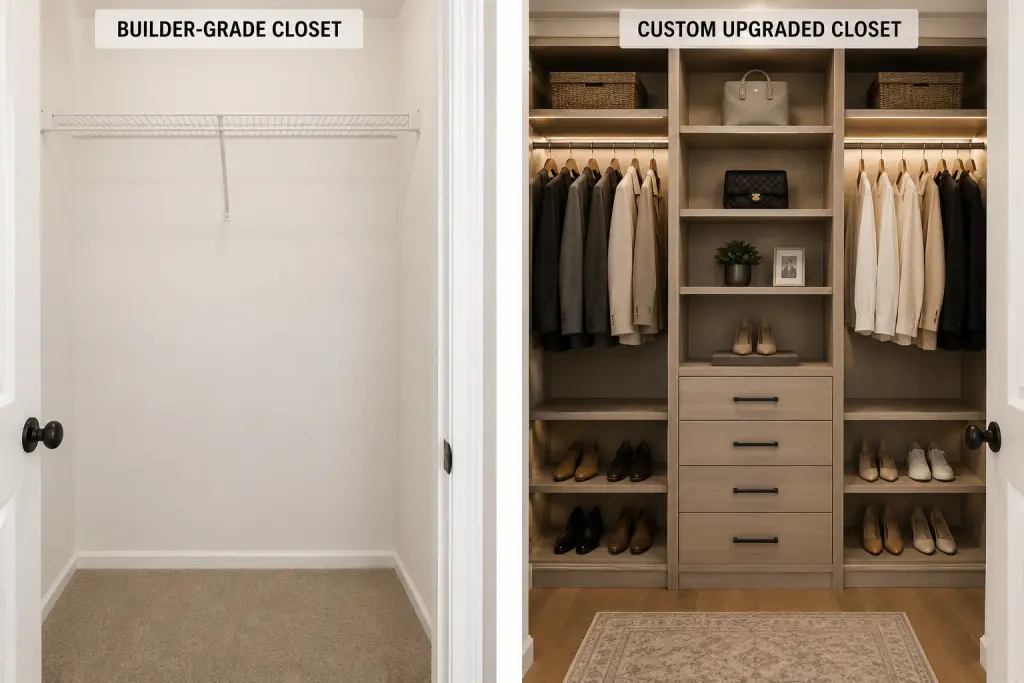
When stepping into a newly constructed luxury home, one expects premium finishes, meticulous craftsmanship, and uncompromising attention to detail. However, an abrupt and disappointing reality often awaits behind the bedroom doors. The standard wire shelf—a ubiquitous fixture in modern construction—stands in stark contrast to the high-end flooring, custom cabinetry, and designer lighting found elsewhere in the residence. While polite society might overlook this glaring inconsistency, a discerning homeowner must confront the reality of builder-grade closets. These rudimentary storage solutions are not merely an aesthetic compromise; they represent a fundamental failure in both form and function.
The Economics of Builder-Grade Closets
To understand why a multi-million dollar property features the same closet shelving as a budget apartment, one must examine the economics of residential development. Builders operate on strict profit margins, constantly seeking areas where costs can be minimized without immediately jeopardizing the initial sale of the property. Closets, hidden behind closed doors, present the perfect opportunity for such fiscal corner-cutting. By installing mass-produced, inexpensive wire racks, developers save thousands of dollars per home, prioritizing highly visible upgrades like quartz countertops over essential, everyday storage infrastructure.
This prioritization reflects a broader industry trend where the closet is treated as a utilitarian afterthought rather than an integral component of the living space. During the chaotic final phases of construction, drywall is finished, paint is applied, and the absolute cheapest, fastest storage solution is hastily mounted to the walls. The wire shelf is favored not for its utility, but for its speed of installation. A single worker can outfit an entire house with wire shelving in a matter of hours, utilizing basic tools and requiring absolutely minimal carpentry expertise.
Unfortunately, this approach leaves the homeowner with a false sense of a move-in ready home. The buyer inherits a storage system that fulfills the legal and architectural definition of a closet but fails entirely to accommodate a modern wardrobe. The discrepancy between the home's overall luxury and its rudimentary storage quickly becomes apparent once the moving boxes are unpacked, forcing the new owner to either live with the daily inadequacy or immediately invest in a costly replacement.
- Material Cost Discrepancy: Wire shelving costs pennies on the dollar compared to architectural-grade wood or high-density melamine, allowing builders to artificially inflate their overall profit margins on the build.
- Labor Efficiency: The installation of standard wire racks requires no specialized carpentry skills, eliminating the need for developers to hire highly paid, skilled tradespeople for closet outfitting.
- Inventory Standardization: Builders can purchase wire shelving in massive, standardized bulk rolls, simply cutting them to size on-site rather than designing thoughtful, custom layouts for individual floor plans.
- The Illusion of Completeness: A basic wire shelf allows the builder to check the closet included box on the final inspection sheet, satisfying basic appraisal requirements without providing genuine, lasting value to the buyer.
- Deferred Upgrades: Developers often intentionally leave closets bare-bones, knowing perfectly well that third-party custom closet companies will eventually absorb the burden of creating functional storage for the homeowner.
Functional Flaws of Standard Wire Shelving
Beyond the purely economic motivations of the builder, the standard wire shelf suffers from severe functional flaws that actively antagonize the user on a daily basis. The most immediate and frustrating of these defects is the inherent instability caused by the wire gaps. A shelf, by its very definition, should provide a flat, stable surface for resting objects. Wire racks utterly fail this basic premise. The parallel metal bars create an uneven, treacherous terrain where anything lacking a wide, perfectly flat base is doomed to tip over.
Furthermore, standard wire systems offer severely limited hanging configurations. A luxury wardrobe consists of diverse garments—from sweeping evening gowns and tailored overcoats to folded knitwear and delicate accessories—each requiring specific spatial accommodations. Builder-grade wire racks typically provide a single, continuous hanging rod positioned at a generic, arbitrary height. This one-size-fits-all approach wastes massive amounts of vertical space and forces the homeowner to cram disparate items into a uniform, highly inefficient line.
The rigidity of this design means that adjustability is virtually non-existent. As a wardrobe naturally evolves, the closet should adapt to accommodate new acquisitions and changing seasons. With wire shelving, the configuration you receive on move-in day is the exact configuration you are trapped with, unless you are willing to tear the system out entirely. This lack of modularity transforms the daily routine of dressing from a seamless, enjoyable experience into an exercise in spatial frustration.
- The Tipping Hazard: Bottles of expensive perfume, lotions, and narrow-heeled shoes inevitably fall through or tip over the wire gaps, creating chaotic, disorganized, and potentially damaging displays.
- Fabric Indentations: Storing folded cashmere sweaters, delicate silks, or premium denim directly on wire racks leaves permanent, unsightly grid creases deeply embedded in the fabric fibers.
- Wasted Vertical Space: The single-rod configuration leaves feet of empty, unusable space below shorter garments like shirts and blouses, space that could be brilliantly utilized for secondary hanging or shelving.
- Hanger Snagging: The metal support brackets that hold the wire shelf interrupt the continuous slide of hangers, making it impossible to smoothly push garments aside when browsing through the wardrobe.
- Inflexible Architecture: The rigid, semi-permanent mounting hardware prevents homeowners from easily adding shelves, adjusting rod heights, or integrating specialized accessory storage as their wardrobe changes.
The Structural Inadequacy of Wire Anchors
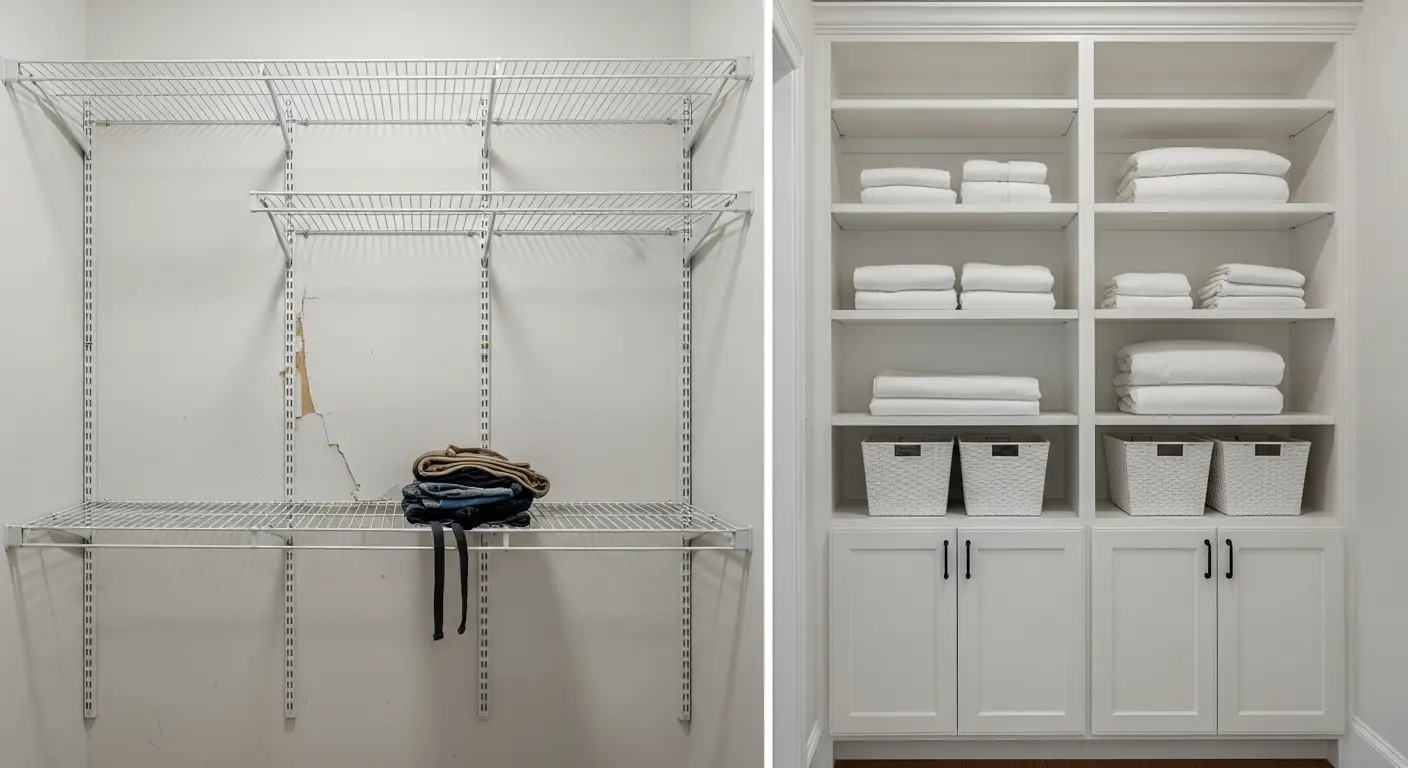
Perhaps the most catastrophic failure of the builder-grade closet lies hidden within the walls: the structural inadequacy of the mounting hardware itself. Wire shelving relies heavily on cheap plastic drywall anchors and diagonal support braces to bear the immense weight of an entire wardrobe. This engineering approach fundamentally misunderstands the sheer mass of a fully loaded closet. Drywall is composed of compressed gypsum dust wrapped in paper; it is absolutely not a load-bearing material designed to withstand relentless downward and outward torque.
As a homeowner gradually fills the closet with heavy winter coats, dense denim, and rows of footwear, the stress on these isolated anchor points increases exponentially. The plastic anchors slowly begin to fatigue, pulling away from the crumbling gypsum and compromising the integrity of the entire installation. This deterioration is often silent and invisible, occurring quietly behind the hanging garments until the exact moment of critical, unavoidable failure.
The inevitable result is the dreaded midnight collapse—a violent tearing of metal and plastic from the wall, sending the entire wardrobe crashing to the floor in a tangled mess. Not only does this catastrophic failure damage the clothing and delicate items stored beneath, but it also leaves behind massive, ragged holes in the drywall. The homeowner is then faced with a multi-step remediation process: patching the drywall, re-texturing, repainting, and ultimately seeking a superior storage solution to replace the ruined wire racks.
- Point-Load Stress: Wire systems dangerously concentrate the entire weight of the wardrobe onto a few isolated plastic anchors, maximizing the stress on weak drywall points rather than distributing it safely across wooden studs.
- Anchor Fatigue: Over time, the constant shifting of hangers and the addition of new garments cause the plastic anchors to wiggle, slowly expanding the drill hole and entirely losing their structural grip.
- Diagonal Brace Intrusion: The angled metal braces required to support the front of the wire shelf intrude aggressively into the storage space, interfering with taller items and creating awkward, unusable pockets of space.
- Catastrophic Failure Cascade: When a single anchor eventually fails, the load is immediately transferred to the adjacent anchors, which are already under maximum strain, triggering a rapid, domino-effect collapse of the entire wall system.
- Extensive Remediation Costs: Repairing the severe damage from a collapsed wire shelf requires professional drywall patching, texturing, and color-matched painting, adding significant hidden costs to the initially cheap builder-grade installation.
Custom Wood and Melamine: The Permanent Cure
The definitive solution to the myriad failures of builder-grade wire shelving is a deliberate transition to custom-designed, architectural-grade wood or high-density melamine systems. These premium materials represent a permanent, elegant cure, elevating the closet from a mere storage utility to a sophisticated extension of the luxury home's interior design. Unlike flexible wire, custom millwork provides a solid, uncompromising foundation for your wardrobe, offering perfectly flat surfaces that treat your garments and accessories with the respect they deserve.
High-density melamine, in particular, offers unparalleled durability and aesthetic versatility for the modern homeowner. Engineered to resist warping, scratching, and fading, it beautifully mimics the luxurious texture and grain of natural wood while providing superior, long-lasting structural stability. When installed by professionals, these systems are anchored directly into the wooden studs of the home, utilizing heavy-duty steel hardware and advanced suspension rails. This engineered load distribution ensures that the closet can bear immense weight without the slightest risk of sagging or catastrophic wall failure.
Beyond structural integrity, custom wood systems introduce an extraordinary level of aesthetic refinement. With premium options for soft-close drawers, glass-front cabinetry, integrated LED lighting, and designer hardware finishes, the closet becomes a bespoke boutique tailored entirely to the homeowner's specific tastes. The total elimination of exposed metal brackets and cheap plastic anchors results in a seamless, built-in appearance that instantly enhances the intrinsic value and daily livability of the luxury residence.
- Unwavering Structural Integrity: Custom systems are anchored firmly and directly into the architectural studs, distributing weight evenly and entirely eliminating the risk of drywall tear-out or shelf collapse.
- Perfectly Flat Surfaces: Solid wood and thick melamine shelving provide a highly stable, perfectly even platform for delicate items, preventing tipping, sagging, and permanent fabric creasing.
- Premium Aesthetic Integration: Custom finishes, decorative crown molding, and seamless edge-banding allow the closet to perfectly match the high-end cabinetry found in the kitchen and master bathrooms.
- Advanced Material Durability: Thermally fused melamine actively resists moisture, scratching, and everyday wear, ensuring the custom closet looks absolutely pristine for decades to come.
- Enhanced Property Value: Upgrading from builder-grade wire to custom architectural millwork transforms the master closet into a major selling point, significantly increasing the overall appraisal value of the luxury home.
Maximizing Space with Custom Configurations
The true power of a custom wood or melamine system lies in its unique ability to maximize every available cubic inch of space through intelligent, highly personalized configuration. Unlike the static, one-dimensional approach of standard wire shelving, custom designs utilize the full verticality of the room. By extending elegant cabinetry from the floor all the way to the ceiling, homeowners capture previously wasted space, transforming it into highly valuable storage for out-of-season items, luggage, or specialized collections.
This personalized approach allows for the precise implementation of dual-hanging zones, elegantly separating shorter items like blouses and trousers from long-hanging garments such as formal dresses and winter overcoats. Drawers can be precisely measured and constructed to accommodate specific items, ranging from shallow, velvet-lined trays for fine jewelry and watches to deep, robust drawers for heavy knitwear. Every single element of the wardrobe is assigned a specific, mathematically calculated home, eliminating visual clutter and drastically streamlining the daily routine.
Furthermore, a custom configuration seamlessly adapts to the specific ergonomic needs of the user. Adjustable shelving allows the sophisticated system to evolve over time, easily accommodating a sudden influx of tall winter boots or a rapidly growing collection of designer handbags. This dynamic adaptability ensures that the luxury closet remains highly functional year after year, providing a serene, perfectly organized environment that fundamentally improves the quality of life within the home.
- Floor-to-Ceiling Utilization: Custom architectural designs capture critical vertical space, adding top-tier shelving for seasonal storage and utilizing the floor space for integrated, angled shoe racks.
- Double-Hanging Efficiency: By strategically stacking two hanging rods on top of each other, custom systems instantly double the available storage capacity for shirts, jackets, and folded trousers.
- Ergonomic Customization: Shelves, premium drawers, and hanging rods are positioned at optimal heights based specifically on the homeowner's stature, significantly reducing unnecessary bending and reaching.
- Specialized Storage Accessories: Custom systems seamlessly integrate luxury features like pull-out valet rods, hidden laundry hampers, sliding tie racks, and custom velvet-lined jewelry drawers.
- Infinite Adjustability: Pre-drilled, discreet system holes allow homeowners to easily move shelves and rods up or down, ensuring the closet effortlessly adapts to future wardrobe changes without ever requiring tools.