
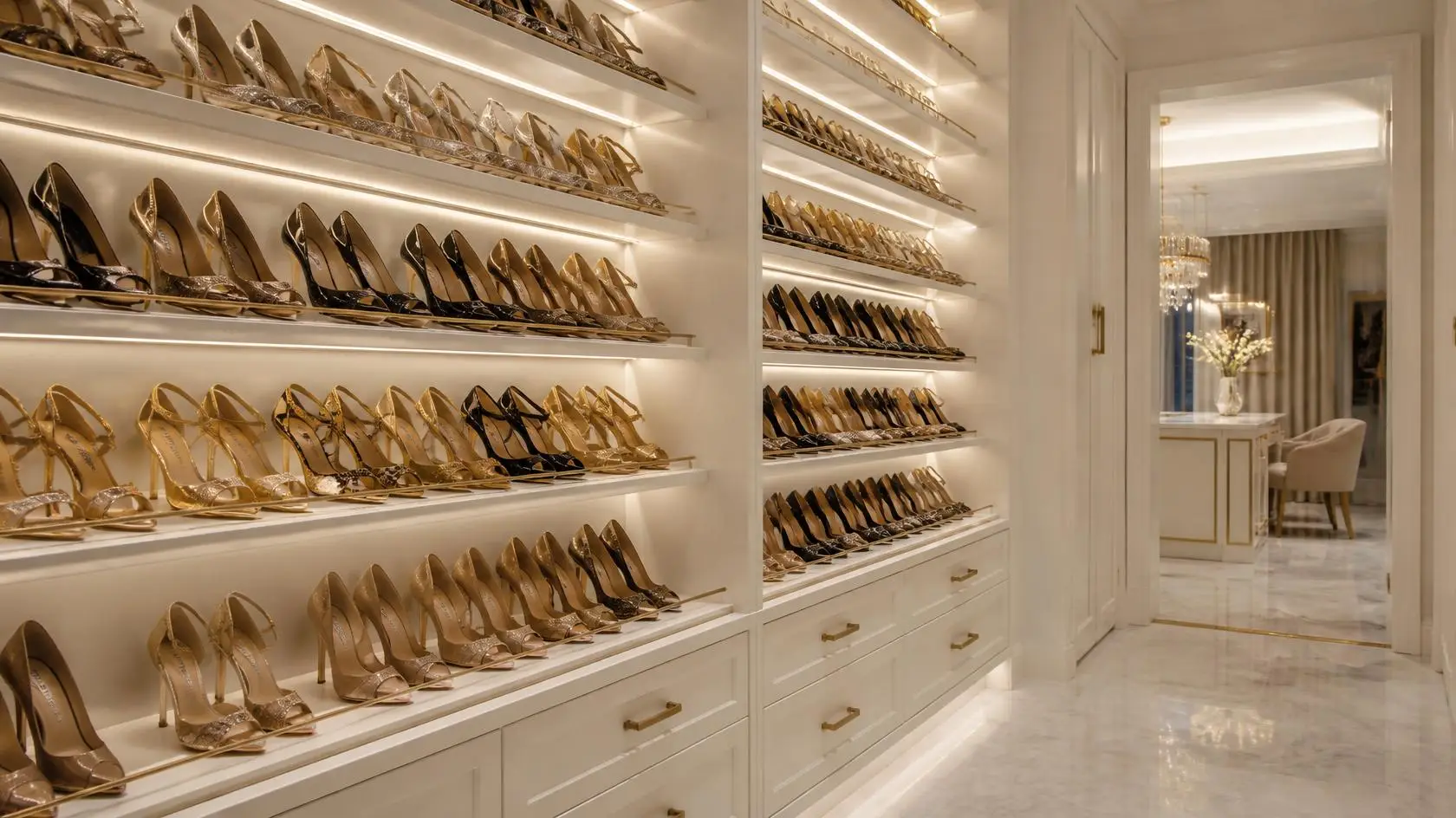

Custom Shoe Closet Ideas for Better Storage, Shelving & Design
A shoe closet is a dedicated, custom-designed storage space engineered to organize, protect, and display footwear efficiently. Utilizing tailored adjustable shelving, angled display racks, integrated LED lighting, and pull-out trays, a modern shoe closet maximizes vertical space while preserving shoe shape and quality. It transforms messy floors into accessible, luxury storage suited for walk-in suites, master bedrooms, and entryway mudrooms.
What Is a Shoe Closet and Why Do You Need One?
It is a specialized storage system designed specifically to accommodate various footwear styles—from high heels and knee-high boots to low-profile sneakers—while keeping them accessible, visible, and protected from wear, dust, and crushing. Unlike standard flat closet shelving, dedicated shoe closets utilize specialized depths, angled displays, and adjustable components to maximize spatial efficiency.
CUSTOM SHOE CLOSET SYSTEM
Vertical Shelving Angled Display Shelves Boot & Tall Shoe Storage Maximizes vertical space Improves visibility and presentation Provides proper clearance for taller footwear Better Visibility • Easier Access • Proper Shoe Care
When footwear is piled on bedroom floors or squeezed into generic bottom shelves, shoes lose their shape, suffer material scuffs, and create visual clutter. Installing a dedicated shoe storage solution fundamentally changes your daily routine. By elevating footwear to eye level and utilizing tailored compartments, homeowners save time during morning routines while drastically extending the lifespan of high-end leather, suede, and athletic footwear.
Beyond mere functionality, custom footwear storage serves as an architectural highlight within modern home designs. Incorporating dedicated footwear displays into master suites or luxury walk-in closets creates a boutique-style atmosphere. It bridges the gap between everyday utility and high-end interior design, turning your personal wardrobe into a organized presentation.
How Do I Choose the Best Shoe Closet Layout for My Space?
Choosing the best shoe closet layout requires evaluating your total shoe count, the specific mix of footwear heights, and your available physical footprint. Walk-in luxury closets benefit from full-height perimeter shoe walls, reach-in closets thrive with pull-out slatted racks, and entryways rely on narrow, vertical drop-down cabinet designs.
Layout Type Best Suited For Ideal Footwear & Use Full Shoe Wall Large Walk-In Closets Large shoe collections, heels, sneakers, and statement footwear Pull-Out Shoe Racks Reach-In Closets & Compact Spaces Flats, loafers, sneakers, and everyday shoes Angled Shoe Shelving Walk-In Closets & Display Areas Heels, dress shoes, and footwear intended for display Boot Storage Walk-In Closets, Mudrooms & Entryways Tall boots, winter boots, and everyday boot storage
Walk-In Shoe Walls
A dedicated shoe wall serves as the centerpiece of a primary bedroom walk-in suite. By utilizing full vertical height from floor to ceiling, a shoe wall provides complete visibility over your entire collection. Incorporating backlighting and adjustable shelf heights allows you to showcase statement pieces alongside daily essentials without sacrificing accessibility.
Reach-In Shoe Storage
For traditional bedroom closets with shallow depths (typically 24 inches), specialized hardware keeps footwear organized without stealing hanging space. Slatted pull-out trays, rolling drawers, and door-mounted vertical racks allow you to store shoes 2 to 3 pairs deep while keeping every item easily reachable with a smooth glide.
Entryway & Mudroom Systems
Entryway shoe organization focuses on high-traffic durability and soil management. These units utilize open cubbies for quick shoe changes, ventilated lower drop-zones, and integrated bench seating. They prevent outdoor dirt from entering main living spaces while maintaining a clean front-entry presentation.
What Are the Best Shoe Storage Features for Luxury Bedrooms?
The best luxury shoe storage features include angled display shelves with brushed metal toe stops, integrated motion-activated warm LED lighting, glass-front display cabinets, and custom velvet-lined pull-out trays. These features combine aesthetic elegance with active preservation for luxury heels, designer sneakers, and seasonal footwear.
👑 Essential Layers of Luxury Shoe Storage
- Micro-Suede & Velvet Pull-Out Trays Protects delicate soles and custom accessories with soft-touch lining.
- Angled Shelves with Metal Toe Stops Presents shoes at a 30° viewing angle while keeping them securely in place.
- 3000K Warm LED Strip Channel Lighting Casts indirect, shadow-free illumination across every tier.
- Glass-Front Enclosed Cabinets Shields high-value designer collections from ambient dust and UV exposure.
Integrating custom footwear storage into high-end bedroom suites elevates a home's aesthetic while keeping items pristine. Here are the defining elements of a luxury setup:
- Angled Display Racks: Set at a 30-degree incline, angled shelves present shoes at the optimal viewing angle, mimicking high-end retail boutiques. Metal accent rails prevent shoes from sliding forward.
- Integrated Strip Lighting: Recessed LED channels (3000K warm white) cast soft, indirect illumination directly onto shelves, eliminating dark shadows on lower racks.
- Enclosed Glass Cabinets: For high-value designer collections, tempered glass-front cabinetry protects sensitive leathers and suedes from ambient dust and UV exposure.
- Custom Boot Suspension: Tall boots often crease or flop over when left on flat surfaces. Custom hanging boot clips or built-in padded boot forms maintain shaft integrity.
How Much Does a Custom Shoe Closet Cost?
A custom shoe closet typically costs between $1,000 and $15,000+, depending on its size, materials, cabinetry, lighting, and level of customization. Simple reach-in shoe storage sits at the lower end of the range, while luxury walk-in shoe closets with premium cabinetry, glass-front displays, and integrated lighting can cost $6,000 to $15,000 or more.
| Shoe Closet Type | Typical Installed Cost | Included Features |
| Reach-In Shoe Closet | $1,000 – $2,500 | Durable melamine shelving, adjustable shelves, multiple shoe levels, and practical open storage. |
| Custom Built-In Shoe Closet | $2,500 – $6,000 | Custom shelving, angled shoe displays, soft-close drawers, decorative hardware, and optional accent lighting. |
| Luxury Walk-In Shoe Closet | $6,000 – $15,000+ | Premium cabinetry or wood finishes, floor-to-ceiling shoe displays, glass-front cabinets, integrated LED lighting, drawers, and custom accessory storage. |
Key Cost Factors Explained
1. Material Choice
Thermally fused laminate (TFL) offers extreme scratch resistance and budget stability, making it popular for high-use closets. Solid hardwoods, custom stained veneers, and painted lacquer finishes represent premium investments that increase overall project costs.
2. Specialized Hardware
Standard flat shelves are economical. However, adding high-grade soft-close pull-out trays, heavy-duty glides, metal fence rails, and custom angled brackets incrementally adds to the total hardware budget.
3. Integrated Electronics
Low-voltage LED system wiring, transformer placement, touch dimmers, and motion sensors require precise millwork channel routing and electrical installation, contributing to the overall labor and material investment.
Custom Shoe Closets vs. Pre-Made Organizers: Which Is Better?
Custom shoe closets are superior for long-term durability, exact spatial fit, weight capacity, and tailored dimensions for specific footwear collections. Pre-made organizers offer low initial costs and immediate installation, but often waste vertical space, use inferior particle board, and lack the strength required for heavy boot storage.
| Feature | Custom Shoe Closet | Pre-Made Organizer |
|---|---|---|
| Space Utilization | Designed to fit the exact dimensions of the space | Standard sizes may leave unused space |
| Shelf Adjustability | Shelving can be customized for different shoe types and heights | Adjustment options vary by system |
| Storage Capacity | Designed around the homeowner’s specific shoe collection and storage needs | Limited to predetermined configurations |
| Materials & Durability | Choice of higher-quality materials, finishes, and hardware | Materials and hardware vary by product and price point |
| Design Integration | Can coordinate with the room’s cabinetry, finishes, lighting, and overall style | Limited to available styles, colors, and finishes |
While off-the-shelf plastic cubbies or light wire racks seem convenient, they frequently fall short in real-world scenarios. Standard store-bought units assume all shoes share identical dimensions. They fail to accommodate winter work boots, high-top sneakers, or tall heels efficiently, resulting in wasted shelf height.
Custom systems utilize adjustable pin systems, letting you change shelf intervals on 32mm standards. As your collection evolves across seasons, shelf spacing adjusts instantly to prevent squishing or underutilizing valuable cabinet space.
What Are Common Shoe Closet Design Mistakes to Avoid?
The most common shoe closet design mistakes include choosing uniform shelf heights, failing to account for proper ventilation, using insufficient shelf depth, neglecting lighting on lower levels, and ignoring seasonal shoe rotation needs. Avoiding these errors ensures long-term functionality and protects footwear investments.
- Uniform Shelf Heights: Footwear varies dramatically in height. Setting all shelves at 7 inches leaves flats with wasted overhead space while forcing ankle boots to be stored sideways.
- Inadequate Shelf Depth: Standard footwear requires 12 to 14 inches of shelf depth. Oversized sneakers or men's shoe sizes 12 and above often hang off 10-inch retail shelves, preventing cabinet doors from closing cleanly.
- Ignoring Air Ventilation: Leather and athletic footwear require airflow to dry completely after wear. Enclosed cabinets without passive rear ventilation vents trap moisture, leading to odors and material degradation.
- Neglecting Lower Shelf Visibility: Unlit lower shelves become dark drop-zones where shoes get forgotten. Extending LED channels or pull-out drawer hardware to bottom levels keeps every pair visible.
Step-by-Step Guide: How to Organize a Shoe Closet Effectively
To organize a shoe closet effectively, start by purging unworn pairs, group remaining footwear by style and frequency of use, adjust shelf heights to fit specific heel and shaft dimensions, place high-traffic pairs at eye level, and store out-of-season footwear on upper shelves.
6 Steps to Organize a Shoe Closet
01 Purge & Edit → 02 Categorize → 03 Match Shelf Heights → 04 Assign Storage Zones → 05 Place by Frequency of Use → 06 Rotate Seasonally
- Purge and Categorize: Remove every pair of shoes from your current closet. Separate them into daily wear, work/formal, athletic, seasonal, and donation piles.
- Measure Footwear Dimensions: Group your shoes by height (flats/sneakers, mid-heels/ankle boots, tall boots) and measure the tallest pair in each group to set correct shelf gaps.
- Establish Eye-Level Zones: Reserve the prime real estate between chest and knee height for your 4 to 6 most frequently worn pairs.
- Invert High Heels for Density: Place high-heeled shoes facing opposite directions (one toe facing out, one heel facing out) on shelves. This clever trick fits 15–20% more shoes per shelf.
- Utilize Clear Boot Shapers: Insert acrylic or padded boot trees into tall boots before placing them on shelves to maintain vertical structure and eliminate ankle creases.
- Rotate Seasonally: Move summer sandals to upper perimeter shelves during winter months, lowering cold-weather footwear into active daily zones.
Expert Tips for Preserving Leather and Suede in Storage
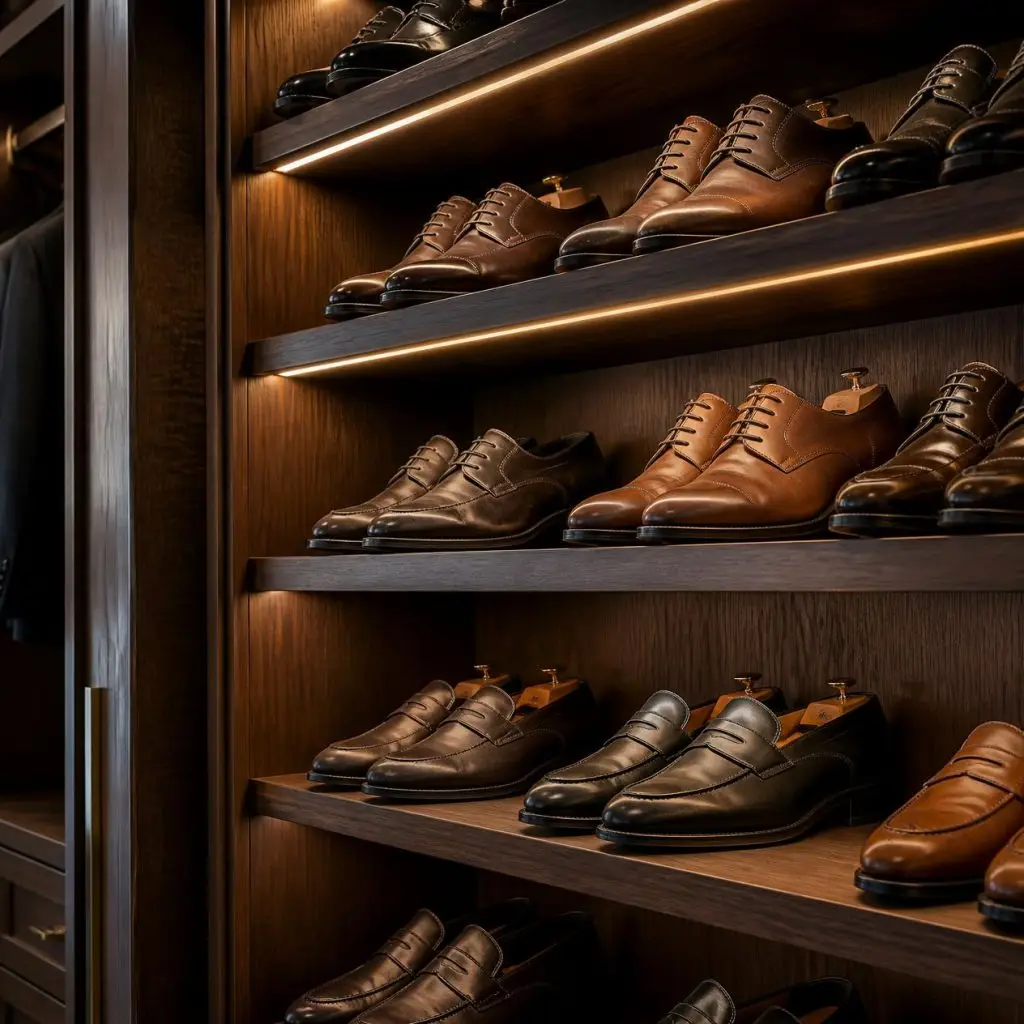
To preserve leather and suede shoes in storage, maintain climate-controlled room temperatures between 60°F and 70°F, keep humidity around 45–50%, use aromatic cedar shoe trees, keep footwear out of direct sunlight, and leave a minimum 1-inch air gap between pairs on shelves.
Ideal Storage Conditions
Temperature Humidity Ventilation Light Exposure 60–70°F 45–50% Gentle air circulation Away from direct sunlight
Help maintain shape and manage moisture.
UV-Protected Storage
Helps reduce fading and prolonged light exposure.
High-end footwear is an investment that degrades quickly under improper storage conditions. Direct sunlight through bedroom windows dries out natural leathers and bleaches suede dyes over time. Placing UV-filtering window treatments or opting for tint-protected glass-front cabinet doors protects footwear finishes.
Avoid plastic storage boxes for natural leathers. Trapped humidity causes mold growth, while volatile organic compounds in synthetic boxes break down shoe glues. Opt for breathable cotton dust bags or open adjustable shelving with cedar shoe trees to absorb interior foot moisture and maintain tension across shoe uppers.
Frequently Asked Questions About Shoe Closets
How deep should a custom shoe closet shelf be?
A custom shoe shelf should ideally be 12 to 14 inches deep. This depth comfortably accommodates standard women's and men's footwear up to size 13 without heels or toes extending past the edge. For larger shoe sizes or bulky winter boots, 15-inch depth is recommended.
How much vertical space do I need between shoe shelves?
Vertical space depends on footwear type. Allow 6 to 7 inches for flats, sandals, and low sneakers; 8 to 10 inches for high heels and ankle boots; and 16 to 20 inches for mid-calf and tall knee-high boots. Installing adjustable shelf tracks offers the best long-term flexibility.
Is it better to store shoes in boxes or on open shelves?
Open shelves are better for everyday visibility, convenient access, and proper air circulation. Original cardboard shoe boxes protect rare or seasonal shoes from dust, but they obscure visibility. Clear, ventilated acrylic boxes offer a balanced alternative for long-term collector storage.
How do you prevent shoe closets from smelling?
Prevent odors by ensuring proper air ventilation within cabinetry, allowing shoes to air out for 24 hours before storing them in enclosed cabinets, using aromatic cedar inserts, and placing natural activated charcoal odor-absorbing bags on lower shelves.
Can you add shoe storage to a small reach-in closet?
Yes. Reach-in closets benefit greatly from pull-out slatted shoe drawers, vertical over-the-door rack hardware, or adjustable bottom-tier shelving inserts. Utilizing pull-out mechanisms doubles storage density by utilizing full closet depth without blocking access.
What is the best lighting for a luxury shoe display?
The best lighting is continuous LED strip channel lighting installed vertically along cabinet side panels or recessed under individual shelf fronts. A color temperature of 3000K (warm white) accurately reflects true footwear colors without generating damaging heat.
How many pairs of shoes fit on a 36-inch closet shelf?
A standard 36-inch wide shelf comfortably holds 4 pairs of average men’s shoes or 4 to 5 pairs of women’s shoes. Utilizing toe-to-heel alternating placement strategies can occasionally allow up to 5 full pairs on a 36-inch shelf.
Are angled shoe shelves worth the extra cost?
Yes, angled shoe shelves are worth it for walk-in suites and designer collections where visual presentation is prioritized. They allow you to see footwear profiles clearly at lower or higher shelf levels. However, flat shelves store slightly more pairs per square foot.
How do I store tall boots without ruining their shape?
Store tall boots using rigid acrylic or foam boot shapers inserted inside the shaft to keep them upright. Alternatively, install custom boot suspension tracks featuring non-marking hanging clips that hold boots off the floor surface.
What materials are best for mudroom shoe closets?
Thermally fused laminate (TFL) and moisture-resistant marine-grade plywood are best for mudrooms. These materials withstand wet soles, melting snow, road salt, and abrasive dirt far better than painted wood or low-grade particle board.
Transform Your Home with Custom Storage Solutions
Designing a functional, beautiful shoe storage system requires balancing spatial engineering with refined interior design. Whether you want to turn a spare wall into a boutique shoe display or seamlessly blend a custom shoe closet into a broader master suite remodel, tailored craftsmanship makes all the difference. Explore full-home custom storage possibilities, layout options, and primary bedroom integration guides at Clear Closets to build a home environment where every item has its perfect place.