
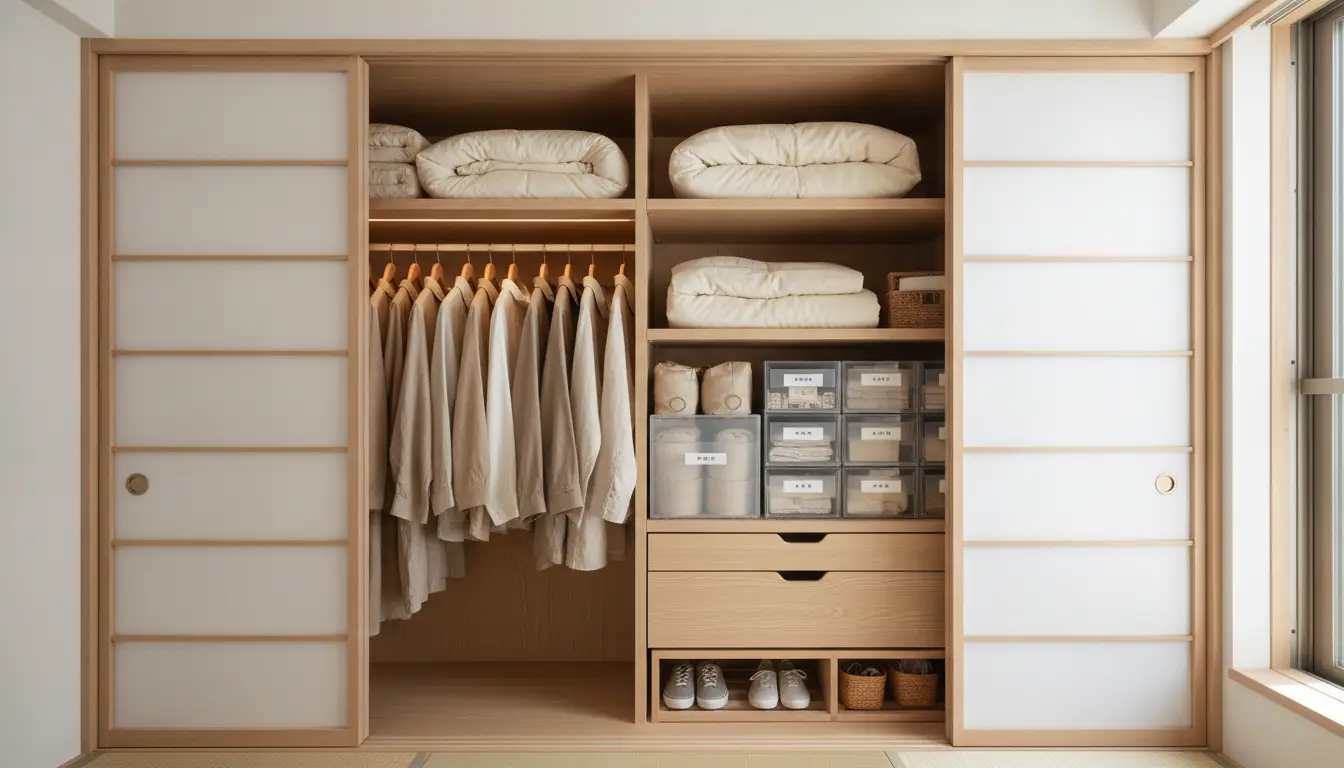

Japanese Closets: How Storage Functions in Japan
Closets in Japan function primarily as deep, multi-tiered storage spaces designed to accommodate traditional bedding like futons alongside daily clothing. Unlike shallow Western wardrobes, the classic Japanese oshiire is split horizontally into distinct upper and lower sections, utilizing specialized airflow techniques to prevent mold and maximize compact urban living spaces effectively.
What Are The Main Types Of Japanese Closets?
The main types of Japanese closets include the traditional oshiire, designed specifically for folding and storing futons, and the modern kurozetto, which mirrors Western-style wardrobes with hanging rods. Additionally, walk-in closets are becoming increasingly popular in newly constructed Japanese homes and renovated apartments for maximum storage capacity.
The oshiire represents the quintessential Japanese storage solution, deeply rooted in the architectural history of washitsu (tatami mat rooms). These closets are distinctively deep—often measuring around 90 centimeters—allowing them to comfortably house thick winter futons, zabuton (floor cushions), and bulky seasonal appliances. The horizontal division creates a sturdy middle shelf known as a chudan, which bears the weight of heavy bedding while keeping it elevated from the floor to promote essential air circulation and prevent moisture buildup.
In contrast, the kurozetto is the Japanese adaptation of the Western wardrobe, commonly found in Western-style rooms (yoshitsu) featuring hardwood or laminate flooring. These spaces are shallower, typically around 45 to 60 centimeters deep, and come equipped with a built-in hanger pipe and an upper shelf (makura-dana). This design caters to modern lifestyles where residents prefer hanging their business suits, dresses, and casual wear rather than folding them into deep, dark compartments.
Beyond these standard options, luxury apartments and newly built single-family homes frequently incorporate Walk-In Closets (WIC) or Walk-Through Closets (WTC). These expansive storage areas act as a hybrid, offering the hanging convenience of a kurozetto with the volumetric capacity of an oshiire. Homeowners often customize these spaces with modular shelving, dehumidifying wall panels, and specialized compartments for shoes, bags, and heavy winter coats, reflecting a shift toward highly organized, high-capacity living environments.
- Oshiire: Deep, horizontally divided closets designed specifically for futons and large household items.
- Kurozetto: Shallow, Western-style wardrobes equipped with hanging rods for daily clothing.
- Walk-In Closet (WIC): Large, dedicated storage rooms that are increasingly common in modern Japanese builds.
- Walk-Through Closet (WTC): Dual-entry closets connecting two rooms, optimizing architectural flow and ventilation.
- Tenbukuro: Small overhead storage compartments often located directly above an oshiire for rarely used items.
What Are The Benefits Of Traditional Japanese Storage?
Traditional Japanese storage offers unparalleled benefits in space optimization, versatility, and seasonal adaptability. By utilizing deep horizontal shelving, these closets allow a single room to transition seamlessly from a daytime living area to a nighttime bedroom, maximizing the utility of limited square footage in dense urban environments.
The primary advantage of the oshiire system lies in its transformative impact on room functionality. In a traditional Japanese home, a room is not permanently designated as a bedroom; rather, it serves multiple purposes throughout the day. Because the deep closet can completely conceal bulky futons and pillows during daylight hours, the tatami room can function as a dining area, a study space, or a reception room for guests. This multifunctional approach is a cornerstone of Japanese architectural philosophy, making small homes feel remarkably spacious and uncluttered.
Another significant benefit is the inherent modularity and adaptability of the storage space. Without fixed vertical dividers or permanent hanging rods, the interior of a traditional Japanese closet acts as a blank architectural canvas. Residents can stack clear plastic storage drawers, insert heavy-duty tension rods for hanging clothes, or use specialized vacuum-sealed bags to compress winter bedding. This flexibility ensures that the closet can evolve alongside the user's changing lifestyle, accommodating everything from baby gear to sports equipment with absolutely zero structural modification.
Furthermore, traditional Japanese closets are engineered with the country's challenging climate in mind. Japan experiences intense humidity during the summer months and the tsuyu (rainy season), making moisture management a critical, daily concern. Traditional oshiire are often constructed using natural woods like cedar or paulownia (kiri), which naturally absorb excess moisture and repel insects. The elevated middle shelf also ensures that bedding is not resting directly on the floor, mitigating the risk of condensation and mold growth that plagues poorly ventilated spaces.
- Space Maximization: Enables rooms to serve multiple functions by completely hiding daily bedding.
- Deep Capacity: Accommodates large, awkwardly shaped items and seasonal appliances like kotatsu tables.
- Customizable Interiors: Easily modified with tension rods, rolling carts, and stackable plastic storage bins.
- Climate Adaptation: Utilizes breathable, natural woods to manage naturally high indoor humidity levels.
- Minimalist Aesthetic: Sliding fusuma doors keep visual clutter hidden from view, maintaining a serene environment.
How Much Does It Cost To Build Or Renovate A Japanese Closet?
The cost to build or renovate a Japanese closet ranges from ¥50,000 to ¥300,000, depending on materials, size, and structural modifications. Converting a traditional oshiire into a modern kurozetto is a highly popular renovation that typically costs between ¥100,000 and ¥200,000.
When evaluating the financial investment required for closet construction or renovation in Japan, homeowners must first consider the exact scope of the project. A simple cosmetic update, such as replacing the traditional paper fusuma sliding doors with modern wooden folding doors, is relatively affordable. This minor upgrade usually costs between ¥50,000 and ¥80,000 and can instantly modernize the appearance of a room without altering the internal, load-bearing structure of the closet itself.
A much more frequent and intensive project is the complete conversion of an oshiire into a Western-style kurozetto. This process involves tearing out the sturdy middle shelf (chudan), reinforcing the ceiling and walls to support hanging weight, installing a steel hanging rod, and fitting new bifold doors. Because this requires structural demolition, waste disposal, and skilled carpentry work, the price generally falls between ¥100,000 and ¥200,000. Many young families and expatriates opt for this renovation because hanging clothes is generally preferred over folding them into deep, dark compartments.
For those looking to construct a brand-new Walk-In Closet (WIC) or undertake a high-end custom storage renovation, the costs can escalate significantly. Building a custom WIC with specialized moisture-resistant drywall (such as Ecocarat tiles), built-in LED lighting, and bespoke cabinetry can easily exceed ¥300,000 to ¥500,000. These premium installations focus heavily on long-term durability and climate control, ensuring that expensive garments, silk kimonos, and leather goods are protected from Japan's notorious summer humidity and winter condensation.
- Assess structural needs: Determine if the thick middle shelf must be demolished and removed.
- Select door styles: Choose between traditional sliding doors, modern folding doors, or open concepts.
- Factor in moisture control: Budget for specialized anti-humidity wall panels or cedar lining.
- Hire licensed carpenters: Ensure professionals handle any load-bearing modifications safely.
- Install organization systems: Allocate funds for high-quality hanging rods and modular shelving units.
Japanese Oshiire vs Western Closets: Which Is Best For Your Space?
Choosing between a Japanese oshiire and a Western closet depends heavily on your lifestyle and bedding preferences. An oshiire is best for those who sleep on futons and need deep storage, while a Western closet is ideal for individuals with large wardrobes of hanging clothing.
The fundamental difference between these two storage paradigms lies in their depth and intended primary cargo. The oshiire is a cavernous space, explicitly engineered to swallow thick, folded futons, floor cushions, and bulky seasonal items. Its 90-centimeter depth is a massive advantage for storing large objects but can quickly become a disorganized black hole for small, everyday clothing items. Users often find themselves struggling to access shirts or pants that have been pushed to the very back of the deep shelves.
Conversely, the Western-style closet (kurozetto) prioritizes rapid accessibility and visual organization for clothing. With a shallower depth of around 45 to 60 centimeters, everything hung on the rod or placed on the upper shelf is immediately visible and within arm's reach. This design prevents garments from getting lost in the shadows and significantly reduces the time spent getting dressed in the morning. However, this shallow design makes it nearly impossible to store traditional Japanese bedding without awkwardly crushing or folding the futons into unnatural, damaging shapes.
For individuals living in modern Japanese apartments, a hybrid approach often yields the absolute best results. Many interior designers recommend utilizing an oshiire for long-term, seasonal storage while deploying tension rods in the front half to hang daily wear. Alternatively, converting one room's closet to a kurozetto while leaving another as an oshiire provides the ultimate household balance. Understanding the specific dimensions and physical limitations of each style is crucial for optimizing the notoriously compact nature of Japanese real estate.
| Feature | Traditional Oshiire | Western Kurozetto |
|---|---|---|
| Depth | Deep (~90 cm) | Shallow (~45-60 cm) |
| Primary Use | Futons, large appliances, seasonal storage boxes | Hanging daily clothing, suits, and dresses |
| Internal Structure | Sturdy middle shelf (chudan) dividing the space | Hanging rod and high top shelf (makura-dana) |
| Accessibility | Harder to reach items stored in the deep rear | Everything is highly visible and within easy reach |
- Choose an oshiire if you prefer sleeping on tatami mats with traditional futons that must be put away daily.
- Choose a kurozetto if you own a large collection of business attire, dresses, or coats that require hanging.
- Use a hybrid approach by installing front-facing tension rods in a deep closet to get the best of both worlds.
What Are Common Mistakes When Using Closets In Japan?
The most common mistakes when using closets in Japan include ignoring humidity control, overpacking deep shelves, and failing to utilize vertical space. Neglecting proper ventilation often leads to severe mold growth, which can ruin expensive clothing, bedding, and the closet's structural wood.
One of the most devastating errors residents make is treating a Japanese closet like a storage space in a dry, Western climate. Japan's rainy season and intensely humid summers create the perfect breeding ground for mold and mildew. Pushing clothing or bedding tightly against the back or side walls restricts essential airflow, trapping moisture. Within a matter of weeks, this trapped humidity can spawn aggressive mold that destroys leather goods, severely stains fabrics, and rots the interior woodwork of the closet.
Another frequent misstep is the failure to properly compartmentalize the deep space of an oshiire. Because these closets are nearly a meter deep, users often shove items to the back and forget about them, creating an inaccessible, cluttered mess. Without the use of wheeled storage carts, deep plastic drawers, or specialized shelving inserts, the rear 50% of the closet becomes virtually dead space. This lack of organization forces users to unpack the entire front half of the closet just to retrieve a single item stored in the back.
Finally, many people fail to maximize the vertical potential of Japanese storage spaces. The upper shelf (makura-dana) and the top of the middle shelf (chudan) offer substantial vertical clearance that is all too often wasted. Stacking loose items leads to chaotic avalanches of clothing. Instead, failing to utilize tension rods, stackable storage bins, or hanging organizers means leaving valuable cubic volume completely empty. Proper spatial planning is absolutely essential to prevent a large closet from feeling restrictive and inadequate.
- Blocking airflow: Pushing items directly against the walls promotes rapid, destructive mold growth.
- Ignoring desiccants: Failing to use moisture-absorbing chemical products during the humid rainy season.
- Wasting deep space: Not using rolling carts or long plastic drawers for the back of the closet.
- Poor vertical planning: Leaving large gaps of unused air space above folded items or bedding.
- Storing damp futons: Putting away bedding before it has been properly aired out and dried in the sun.
How Do I Choose The Best Organization System For A Japanese Closet?
Choosing the best organization system for a Japanese closet requires measuring the exact depth and width of the space, then selecting modular components like tension rods, stackable plastic drawers, and wheeled racks. The goal is to create highly accessible zones for both daily use and long-term storage.
The foundation of an effective Japanese closet organization system begins with precise, meticulous measurements. Unlike standardized Western wardrobes, Japanese closets can vary significantly in their internal dimensions depending on the age of the building and the specific architectural style. Before purchasing any storage solutions, you must measure the depth, width, and height of each compartment. Pay special attention to the clearance around the sliding door tracks, as poorly sized drawers may become trapped behind overlapping fusuma or shoji doors.
Once measurements are secured, the next step is to embrace modular plastic storage. Brands like Muji, Nitori, and Tenma offer extensive lines of deep, stackable plastic drawers specifically engineered to fit the exact dimensions of an oshiire or kurozetto. These translucent drawers allow you to categorize clothing by season, type, or family member while pulling out smoothly to grant access to the very back of the deep closet. Using uniform, modular boxes creates a clean, visually appealing aesthetic while maximizing every square centimeter of available space.
For the front half of the closet, tension rods (tsuppari-bo) are an absolute necessity for renters and homeowners alike. These heavy-duty, spring-loaded poles can be wedged securely between the closet walls to instantly create a hanging wardrobe without the need for screws or permanent modifications. By placing a tension rod near the front of an oshiire, you can hang daily wear like shirts and jackets, while reserving the deep rear space for out-of-season clothing stored in vacuum-sealed bags or modular boxes.
- Measure meticulously: Record the exact height, width, and depth of all compartments, including door track clearance.
- Invest in deep drawers: Purchase plastic storage units (like the Tenma Fits line) designed specifically for 74cm oshiire depth.
- Install tension rods: Use heavy-duty tsuppari-bo to create temporary, damage-free hanging space.
- Utilize rolling racks: Place wheeled bookshelves or wire carts in the lower compartment for easy, pull-out access.
- Implement vacuum bags: Compress bulky winter bedding to save valuable vertical space during the summer months.
What Are The Best Expert Tips For Japanese Closet Maintenance?
The best expert tips for Japanese closet maintenance revolve around proactive moisture management, regular deep cleaning, and seasonal rotation. Utilizing slatted wooden boards (sunoko), chemical dehumidifiers, and routine airing out will protect your belongings and drastically extend the lifespan of the closet interior.
Moisture management is the single most critical aspect of maintaining a closet in Japan. Experts universally recommend lining the floor and the middle shelf of the closet with sunoko—slatted wooden boards typically made from cedar or cypress. These boards elevate your storage boxes and futons a few centimeters off the flat surfaces, creating a vital, uninterrupted channel for air to flow underneath. This simple, traditional technique is highly effective at preventing condensation from forming at the base of the closet, which is the most common starting point for structural mold.
In addition to passive airflow, active moisture absorption is strictly necessary during the humid summer months. You should place disposable chemical dehumidifier tubs (often sold under names like Mizutori Zousan) in the corners of the closet, particularly in the lower compartments where cold, damp air tends to settle. Furthermore, hanging silica gel packets among your clothes and placing charcoal-based deodorizers inside storage boxes will help neutralize musty odors and keep fabrics feeling crisp and fresh throughout the grueling rainy season.
Finally, routine maintenance must include a seasonal "closet diet" and deep cleaning. Twice a year, typically during the transition between summer and winter (koromogae), you should completely empty the closet. This provides an opportunity to wipe down the wooden interior with a dry cloth, vacuum out dust mites, and leave the doors wide open for several hours to allow the space to breathe. During this process, ruthlessly declutter items you no longer need, as an overstuffed closet is the ultimate enemy of good ventilation and efficient daily function.
- Use sunoko boards: Elevate items with slatted wood to ensure continuous under-floor airflow.
- Deploy dehumidifiers: Place chemical moisture absorbers in the lowest, darkest corners and replace them frequently.
- Air out regularly: Leave closet doors open on dry, sunny days to refresh the stagnant air inside.
- Never store damp items: Ensure all clothes and futons are bone-dry before putting them away to prevent mildew.
- Perform seasonal purges: Empty, vacuum, and clean the entire closet space at least twice a year during seasonal transitions.
Frequently Asked Questions About Japanese Closets
This section addresses the most frequently asked questions about how closets function in Japan, covering topics like renting constraints, mold prevention, structural modifications, and the specific everyday uses of traditional architectural features found in Japanese homes.
Navigating the nuances of Japanese real estate and storage can be confusing for newcomers and long-term residents alike. The terminology, the unique dimensions, and the climate-specific challenges require a distinct approach compared to Western storage habits. Understanding these elements is key to maintaining a clean, healthy, and highly organized living space.
Many of the most common inquiries revolve around the strict rules imposed on renters in Japan. Because the vast majority of apartments prohibit drilling holes or making permanent alterations to the walls, tenants must rely heavily on creative, non-destructive organization hacks. Below are detailed answers to the most pressing questions regarding Japanese closet function and maintenance.
Are tension rods safe to use in a rented Japanese apartment?
Yes, tension rods (tsuppari-bo) are completely safe and specifically designed for rental properties. Because they rely on spring-loaded pressure rather than screws or nails, they do not damage the walls. However, you must ensure you do not exceed the weight limit specified on the product, as overloading the rod can cause it to collapse or dent the closet walls over time.
How do I prevent mold from growing in my oshiire?
Preventing mold requires a three-pronged approach: airflow, elevation, and dehumidification. Always leave a gap between your belongings and the closet walls. Use slatted sunoko boards on the floor to elevate items, and place chemical dehumidifier tubs in the corners. On sunny, low-humidity days, open the closet doors to allow fresh air to circulate.
Can I remove the middle shelf of a closet in a rental property?
No, you generally cannot remove the middle shelf (chudan) of an oshiire in a rental apartment without explicit written permission from the landlord or property management company. This shelf is often built into the structural framing of the closet, and removing it constitutes a major alteration that will result in heavy fines or loss of your security deposit.
What is a tenbukuro and how should I use it?
A tenbukuro is the small, overhead storage cabinet located directly above the main oshiire. Because it requires a step stool to access, it is best used for lightweight, rarely needed items. Common uses include storing empty luggage, holiday decorations, or out-of-season blankets. Never store heavy items in a tenbukuro, as retrieving them can be dangerous.
How much weight can the middle shelf of an oshiire hold?
The middle shelf of a properly constructed traditional oshiire is incredibly sturdy and can typically hold between 50 to 80 kilograms of weight. It is designed to support stacks of heavy cotton futons. In popular Japanese culture, characters (like Doraemon) are often depicted sleeping on this shelf, which speaks to its robust, load-bearing construction.
Are walk-in closets common in modern Japanese homes?
While historically rare, Walk-In Closets (WIC) are becoming highly common in newly constructed Japanese homes, condominiums, and renovated apartments. Modern Japanese families accumulate more clothing and goods than previous generations, driving a high demand for Western-style, high-capacity storage rooms that can keep living areas completely clutter-free.
What is the best way to store a futon during the day?
The best way to store a futon is to fold the mattress (shikibuton) into thirds, forming an "S" or "Z" shape. Place this on the middle shelf of the oshiire. Fold the duvet (kakebuton) into quarters and place it on top of the mattress, followed by the pillow. Always ensure the futon has aired out before storing it to prevent trapping nighttime sweat.
How do Japanese sliding closet doors (fusuma) work?
Fusuma doors operate on simple wooden tracks installed in the floor and ceiling frame. They are incredibly lightweight, traditionally made from a wooden lattice covered in thick, opaque paper. If you need full access to the closet width for moving large items, fusuma can be easily lifted up and pulled outward off their tracks to be temporarily removed.
Why do Japanese closets not have built-in lighting?
Traditional Japanese closets rarely feature built-in lighting due to historical architectural practices and fire safety concerns. Because the oshiire was designed to hold highly flammable cotton bedding, introducing wiring and hot bulbs was considered a fire hazard. Today, most people rely on ambient room lighting or install battery-operated motion-sensor LED lights.
Which storage boxes are best for deep Japanese closets?
The best storage boxes are those specifically manufactured to match the 74-centimeter depth of a standard oshiire. Brands like Tenma (with their "Fits" line), Muji, and Nitori produce modular plastic drawer units that maximize this deep space. Avoid shallow Western storage boxes, as they will leave vast amounts of dead space behind them in a traditional Japanese closet.
Action Point:
Ready to optimize your living space? Start measuring your closets today and invest in modular storage solutions to transform your Japanese home.
Contact Us