
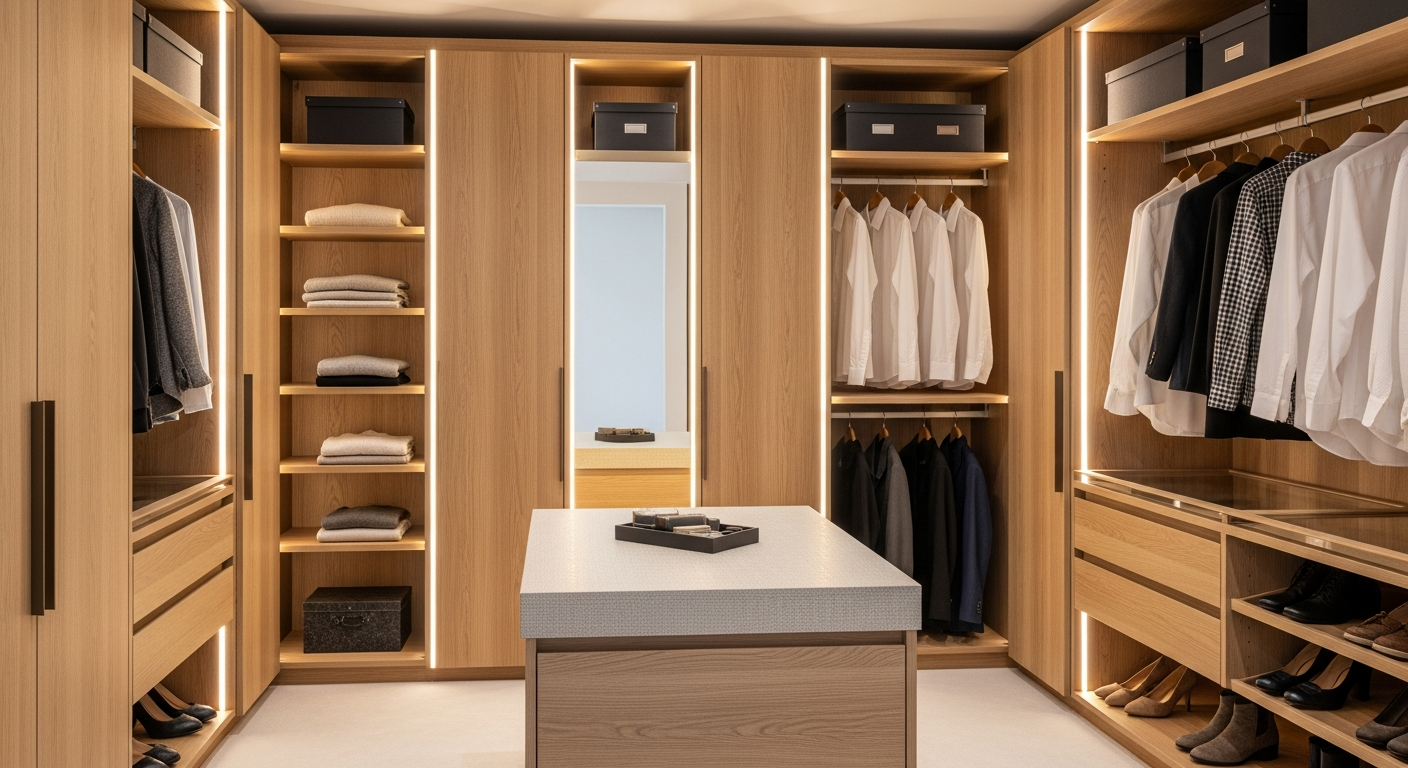

Small Master Closet Storage: Maximize Space
When faced with a diminutive master closet, the immediate instinct for many homeowners is to consider structural expansion. However, tearing down walls, encroaching upon the primary bedroom's square footage, or undertaking expensive architectural renovations is rarely the most efficient solution. The true secret to transforming a cramped closet into a highly functional, luxurious dressing space lies in intelligent spatial optimization. By rethinking the existing volume of the room rather than merely its floor plan, you can uncover a wealth of untapped storage potential. Professional closet designers operate on the principle that every cubic inch matters, treating the closet as a three-dimensional puzzle where strategic layout choices dictate the ultimate capacity and aesthetic appeal.
Achieving this level of optimization requires a systematic approach that addresses the specific pain points of small-space storage. Standard builder-grade closets typically feature a single hanging rod and a solitary top shelf, a configuration that notoriously wastes up to fifty percent of the available vertical volume. By dismantling these inefficient defaults and implementing highly tailored, custom-engineered systems, homeowners can effectively double their storage capacity. This comprehensive methodology relies on advanced vertical storage mechanics, sophisticated drawer organization, strategic illumination, and bespoke layout configurations that collectively trick the eye into perceiving a much grander space.
Vertical Storage Strategies
The fundamental flaw in most residential closet designs is the failure to utilize vertical space. In a standard eight-foot or nine-foot ceiling environment, garments hung on a single rod typically consume only the middle three to four feet of the wall, leaving massive voids near the floor and the ceiling. To counteract this, you must shift your perspective from linear square footage to cubic volume. Implementing a double-hang rod system is the most immediate and impactful upgrade you can execute. By installing one rod at approximately eighty inches from the floor and another directly beneath it at forty inches, you instantly double the hanging capacity for shirts, blouses, skirts, and folded trousers without requiring a single additional inch of floor space.
Beyond double-hanging, the uppermost reaches of the closet must be aggressively targeted for seasonal and low-frequency storage. The space above the top hanging rod, often left completely barren, should be outfitted with shelving that extends all the way to the ceiling line. This is the optimal zone for storing bulky winter sweaters, travel luggage, and archival boxes. To ensure this high storage remains accessible rather than becoming a graveyard for forgotten items, integrate pull-down wardrobe lifts. These hydraulic or spring-loaded mechanisms allow you to effortlessly pull high-hanging garments down to eye level, maximizing the ceiling height while maintaining absolute ergonomic convenience.
Floor-to-ceiling optimization also applies rigorously to footwear. Traditional floor-based shoe racks consume valuable real estate and create a cluttered, chaotic visual plane that makes the closet feel substantially smaller. Instead, dedicate a narrow vertical column specifically for shoes, utilizing adjustable shelving that runs from the baseboard to the ceiling. By spacing the shelves exactly to the height of the specific shoes they hold—flats require merely four inches of clearance, while boots may require twelve to eighteen—you eliminate dead air between shelves and maximize the density of the inventory. This vertical column draws the eye upward, enhancing the perception of height within the small enclosure.
- Install double-hang systems: Set upper rods at 80 inches and lower rods at 40 inches to instantly double the capacity for short garments.
- Utilize wardrobe lifts: Implement hydraulic pull-down rods for spaces exceeding standard reach, making ceiling-height storage fully accessible.
- Build to the ceiling: Install solid shelving units that terminate flush against the ceiling to house luggage, seasonal bins, and bulky items.
- Create vertical shoe columns: Replace floor racks with floor-to-ceiling adjustable shelves, customizing the clearance for flats, heels, and boots.
- Employ cascading hangers: Use tiered hanger systems designed to drop vertically, allowing multiple garments to occupy the horizontal space of a single hanger.
- Add over-the-door storage: If the closet features a traditional swing door, mount rigid vertical rack systems on the interior face for accessories or shoes.
Advanced Drawer Organization
Incorporating built-in drawers into a small master closet is a game-changing strategy that simultaneously increases storage density and reduces visual clutter. Open shelving, while useful for certain items, often leads to messy stacks of clothing that visually overwhelm a tight space. Drawers conceal this visual noise, creating a sleek, streamlined facade that makes the closet feel larger and more serene. Furthermore, drawers allow for the utilization of the entire depth of the cabinetry. When clothes are stacked on deep open shelves, the items in the back are frequently forgotten or become impossibly tangled when retrieved. Drawers, particularly those equipped with full-extension undermount glides, bring the entire inventory out to the user, ensuring that every square inch of the drawer's volume is actively utilized.
To truly maximize drawer efficiency, you must abandon traditional flat-folding techniques in favor of file-folding. Popularized by modern organization experts, file-folding involves folding garments into compact rectangles and standing them upright, edge-to-edge. This method allows you to see every single item in the drawer simultaneously, eliminating the need to dig through stacks and disrupt the organization. When applied to a small master closet, this technique drastically increases the number of t-shirts, leggings, and undergarments a single drawer can hold. To maintain this strict vertical alignment, rigid drawer dividers are absolutely essential. Acrylic or bamboo spring-loaded dividers prevent the folded rows from collapsing as items are removed, maintaining structural integrity and maximizing the usable surface area.
The depth and dimensions of the drawers must be meticulously planned according to the specific wardrobe they will house. A common mistake in custom closet design is installing uniform, deep drawers for all purposes. Deep drawers are excellent for thick winter knits or denim, but they are incredibly inefficient for jewelry, ties, hosiery, or lingerie. For these micro-items, shallow drawers—measuring no more than three to four inches in depth—are vastly superior. By stacking several shallow drawers in the space that one deep drawer would occupy, you create highly specialized zones. Outfitting these shallow drawers with custom-molded velvet inserts or modular acrylic grid trays ensures that every accessory has a dedicated, perfectly sized compartment, preventing tangling and maximizing the horizontal plane.
- Implement full-extension glides: Ensure all drawers pull out completely to allow access to the absolute back of the unit without dead zones.
- Adopt file-folding techniques: Store garments upright like files in a cabinet to increase drawer capacity by up to forty percent compared to flat stacking.
- Install rigid drawer dividers: Use tension-based or custom-fitted dividers to keep file-folded rows upright and separate different categories of clothing.
- Utilize shallow micro-drawers: Dedicate 3-inch deep drawers specifically for small accessories, jewelry, and undergarments to prevent wasted vertical space within the drawer.
- Incorporate velvet grid inserts: Line accessory drawers with compartmentalized trays to keep rings, watches, and ties meticulously organized and densely packed.
- Opt for soft-close mechanisms: While seemingly a luxury, soft-close hardware prevents the shifting of meticulously organized contents when drawers are shut.
Strategic Closet Lighting
Lighting is arguably the most overlooked element in small closet design, yet it possesses the profound ability to alter the spatial perception of the room. A single, centralized overhead fixture—typically a harsh, low-quality builder-grade dome light—casts heavy shadows in the corners and lower regions of the closet. These shadows visually shrink the space, making it feel cavernous, cramped, and oppressive. To counteract this, lighting must be layered and distributed throughout the cabinetry. By illuminating the dark recesses, you push the visual boundaries of the walls outward, creating an optical illusion of expanded square footage. Proper illumination also highlights the organization systems, making the closet feel like a high-end boutique rather than a storage closet.
The integration of linear LED channel lighting is the most effective way to achieve this boutique aesthetic while maximizing visibility. Extruded aluminum channels fitted with high-density LED tape should be routed directly into the underside of shelving and along the interior vertical panels of the cabinetry. This provides direct, task-oriented illumination over hanging garments and folded stacks, entirely eliminating shadows. For optimal color rendering—which is crucial when distinguishing between a navy blue suit and a black one—ensure the LEDs have a Color Rendering Index (CRI) of 90 or higher, and a color temperature between 3000K and 4000K. This mimics natural daylight, ensuring colors remain true and the space feels bright and airy.
If hardwiring new electrical circuits is not feasible due to budget or structural constraints, modern battery-operated solutions offer exceptional performance without the need for invasive electrical work. High-lumen, rechargeable lithium-ion puck lights and motion-sensing LED light bars can be easily mounted using magnetic strips or heavy-duty adhesives. Placing motion-activated lights inside deep drawers or above shoe racks ensures that illumination is provided exactly when and where it is needed. Furthermore, incorporating backlighting behind a strategically placed mirror or using illuminated closet rods can add incredible depth to the space, distracting from the tight physical dimensions and focusing the eye on the luminous architectural details.
- Eliminate single overhead fixtures: Replace central dome lights with distributed lighting to eradicate shadows that visually shrink the room.
- Install linear LED channels: Route LED tape lights into the underside of shelves to provide direct, shadow-free illumination over garments.
- Prioritize high CRI ratings: Select lighting with a Color Rendering Index of 90+ to ensure accurate color representation of your wardrobe.
- Utilize motion-sensor technology: Implement automated lighting that activates upon entry or when opening a drawer, ensuring instant visibility without manual switches.
- Deploy rechargeable LED bars: Use magnetic, USB-rechargeable light bars in rentals or spaces where hardwiring electrical circuits is impossible.
Custom Layout Configurations
The ultimate success of a small master closet relies on a layout configuration that is explicitly dictated by a rigorous inventory of your specific wardrobe. There is no universal template for a small space; a homeowner with a vast collection of long evening gowns requires a drastically different layout than one whose wardrobe consists entirely of folded athletic wear and business suits. Before installing any hardware, you must measure the linear footage of your current hanging garments, categorized by short-hang (shirts, folded pants), medium-hang (dresses, long coats), and long-hang. By allocating exact dimensional zones for these specific categories, you eliminate the wasted vertical space that occurs when a short shirt is hung in a long-hang section. This precise, inventory-driven layout ensures that every cubic inch is purpose-built.
In tight, walk-in configurations, corners are notoriously problematic, often becoming dark, inaccessible dead zones where clothing goes to be forgotten. To maximize a small footprint, these corners must be engineered with precision. One highly effective strategy is the implementation of curved corner hanging rods, which allow hangers to glide seamlessly around the 90-degree angle, maintaining continuous use of the space. Alternatively, if the layout calls for shelving in the corner, utilize blind-corner pull-out systems or spinning carousel hardware—similar to kitchen cabinet lazy Susans—adapted for shoes or folded garments. By resolving the awkward geometry of corners, you reclaim significant storage volume that is typically abandoned in standard designs.
Finally, a small closet must heavily rely on multi-functional, retractable accessories that provide high utility without permanently consuming space. Valet rods are an indispensable addition; these telescoping metal rods pull out when you need to stage an outfit for the next day or hang dry cleaning, and slide completely flush into the cabinetry when not in use. Similarly, sliding tie racks, retractable belt hooks, and fold-down ironing boards offer dedicated storage and function that disappears on command. Even mirrors should be integrated strategically; a full-length mirror mounted on a heavy-duty pivot glide can slide out from a narrow three-inch gap between cabinets, providing a dressing room experience that reflects light and creates the illusion of depth, all while requiring virtually zero permanent wall space.
- Conduct a rigorous wardrobe inventory: Measure the exact linear footage of your short, medium, and long hanging garments to dictate the custom zone dimensions.
- Engineer corner solutions: Utilize curved hanging rods or rotating carousel shelves to prevent 90-degree corners from becoming inaccessible dead zones.
- Install retractable valet rods: Add telescoping rods for staging outfits or hanging dry cleaning that push flush into the cabinetry when not in use.
- Integrate sliding accessory racks: Mount pull-out tie, belt, and scarf racks along the vertical panels of the cabinetry to utilize narrow gaps.
- Incorporate slide-out mirrors: Mount a full-length mirror on heavy-duty drawer glides to pull out from between cabinets, saving wall space while reflecting light.
- Vary shelf depths strategically: Use 12-inch deep shelves for shoes and 14-to-16-inch deep shelves for folded garments to maintain optimal clearance in the walkway.