
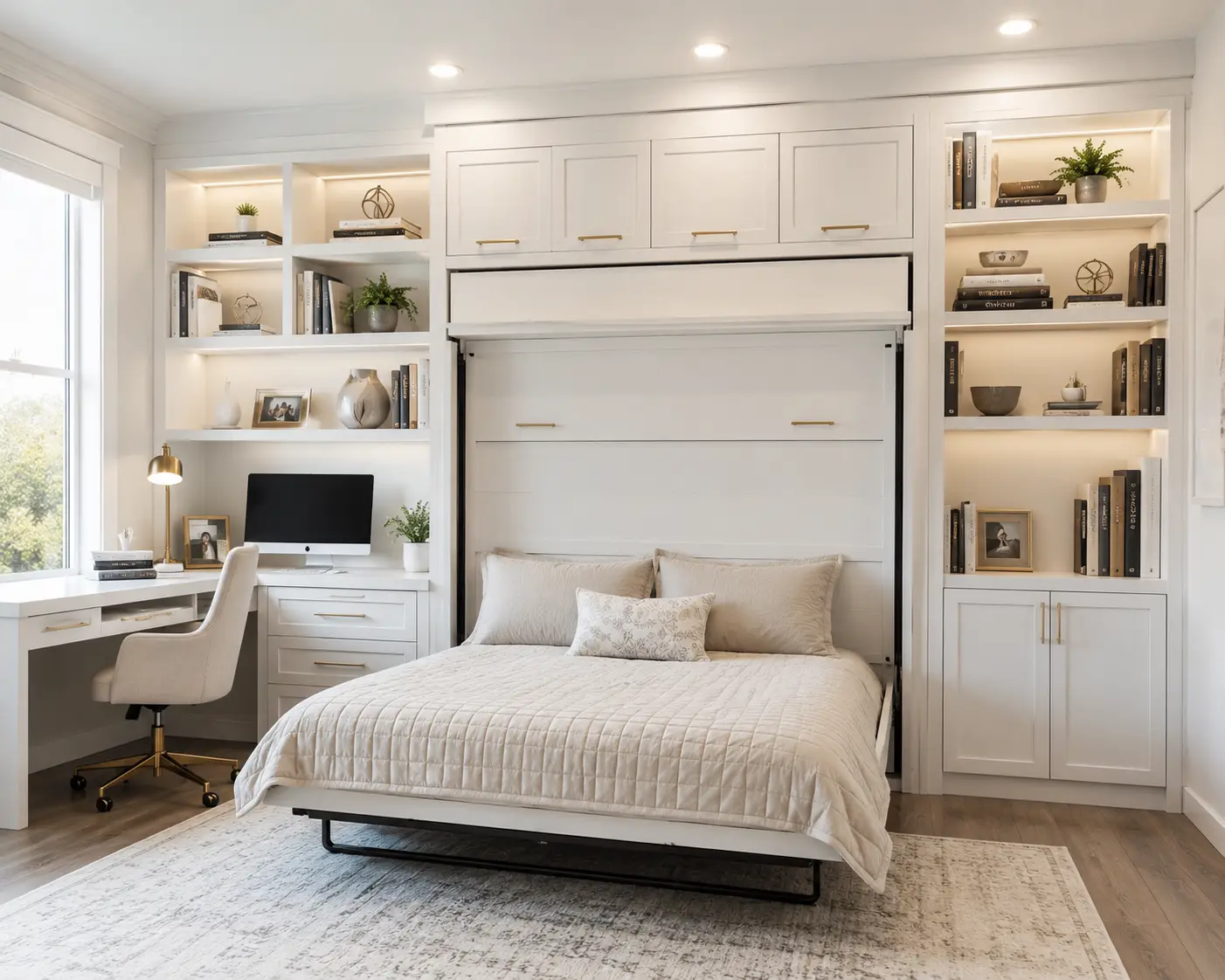

Murphy Beds with Smart Storage and Modern Designs
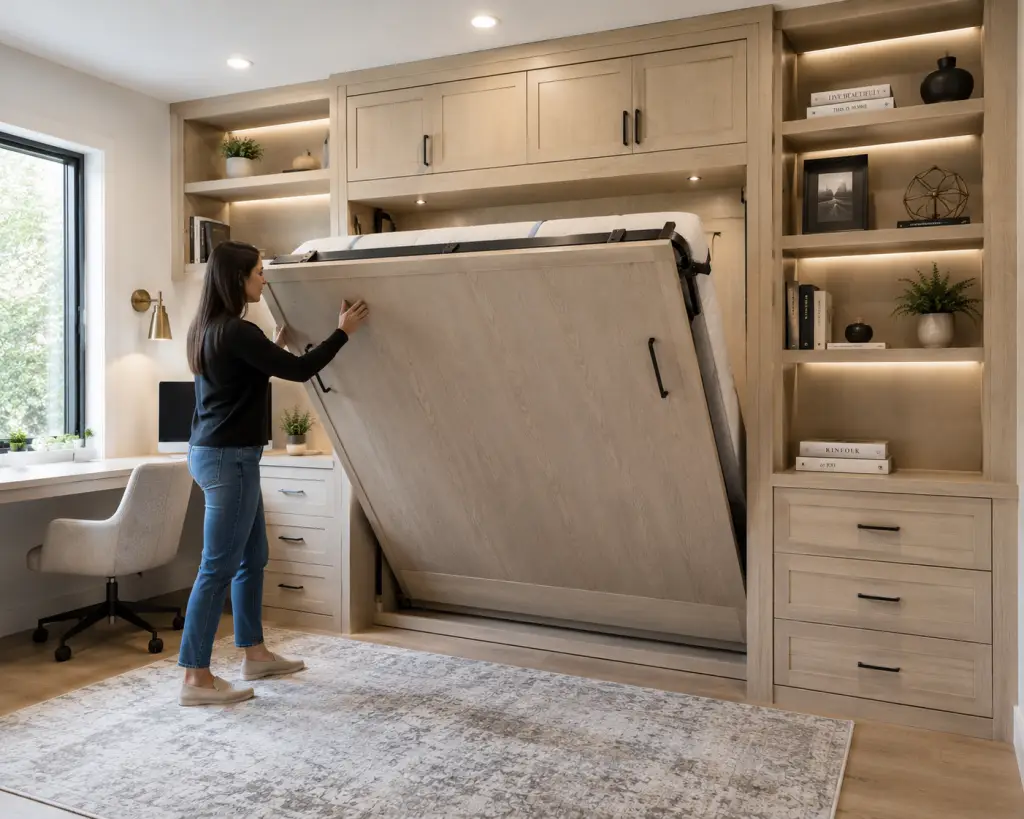
Murphy beds (also known as wall beds) are pull-down bedding systems hinged inside vertical cabinets or wall enclosures. Operating on counterbalanced piston or spring mechanisms, murphy beds allow a full-sized mattress to store vertically against a wall when not in use. This converts guest bedrooms, home offices, and basements into multi-functional living spaces without sacrificing floor area.
Table of Contents
What is a Murphy Bed and How Does It Function?
A murphy bed is a space-saving furniture system engineered to lift a standard mattress vertically into a decorative wall cabinet. Operating on heavy-duty counterbalanced lift mechanisms, these systems allow a single room to serve as a high-capacity home office, gym, or playroom during the day, and a comfortable bedroom at night.
In modern residential architecture, maximizing usable square footage is a top priority for homeowners. Traditional guest rooms often sit empty 90% of the year, wasting 120 to 200 square feet of valuable floor space on a stationary bed frame.
Integrating a fold-down bed system solves this spatial inefficiency. By pairing a pull-down bed frame with surrounding custom cabinetry, you reclaim the central floor area for daily activities. Through smart space planning, wall beds fold away smoothly, transforming raw wall space into built-in desks, book towers, and storage units without disturbing your main room layout.
What are the Main Benefits of Installing a Murphy Bed System?
Installing a wall bed maximizes living space, creates multi-purpose rooms, and provides real mattress comfort for houseguests. Furthermore, surrounding wall beds with high-quality built-in storage made from durable materials turns empty walls into functional millwork, directly improving everyday household organization and raising your home's long-term resale value.
- Multi-Functional Space Planning: Turns a single room into a dual-purpose space, such as a home office by day and a guest suite by night.
- Real Mattress Comfort: Unlike uncomfortable pull-out sofa beds or air mattresses, wall beds accommodate standard coil or memory foam mattresses up to 12 inches thick.
- Integrated Storage Solutions: Surrounding cabinets can feature clothing hanging rods, library bookshelves, file drawers, and floating desktops.
- Increased Residential Equity: In luxury homes, custom wall bed systems act as permanent architectural features that appeal heavily to potential buyers.
How Much Do Custom Murphy Beds Cost?
Custom Murphy beds typically cost between $3,000 and $15,000+, depending on size, materials, lift mechanism, and surrounding cabinetry. While basic standalone wall beds sit on the lower end, full-wall units featuring custom office desks, glass display towers, and lighting occupy the premium tier.
To help you budget for your room transformation, let us review the average price ranges:
| Project Scope | Average Price Range | Key Features & Structural Highlights |
| Full Wall Murphy Bed System | $7,000 – $15,000+ | Queen size frame; natural white oak or walnut wood veneers; built-in desk; side cabinets; integrated LED lighting. |
| Built-In Murphy Bed System | $3,500 – $7,000 | Piston or spring mechanism; painted MDF or plywood box; shaker cabinets; soft-close drawers; crown molding. |
| Basic Murphy Cabinet Bed | $2,000 – $3,500 | Standalone cabinet frame; standard piston mechanism; basic laminate or painted finish; no side storage towers. |
Piston vs. Spring Lift Mechanisms: Which is Best?
The choice between piston gas springs and steel spring mechanisms comes down to longevity, smooth operation, and maintenance needs. Gas pistons offer whisper-quiet, fluid movement with fewer moving parts, whereas steel spring systems are highly adjustable for heavy mattresses but require periodic tension adjustments over time.
Lift Mechanisms Compared
Understanding the mechanics behind pull-down beds ensures your system operates safely and effortlessly:
| Feature | Gas Piston Mechanisms | Steel Spring Mechanisms |
| Operation & Feel | Smooth, continuous hydraulic motion; requires minimal physical force to lift or lower. | Firm, counterbalanced pull; tension changes slightly as the mattress lowers. |
| Noise Level | Whisper-quiet with zero squeaking or metallic creaks during movement. | May produce minor spring tension creaks over years of extended use. |
| Adjustment & Maintenance | Sealed units requiring zero maintenance; replaced as a single module if pressure drops. | Adjustable spring counts to fine-tune lifting power for different mattress weights. |
| Safety Features | Built-in pressure stops prevent the bed from dropping or snapping closed accidentally. | Requires proper spring calibration to prevent sudden recoil or heavy drops. |
MDF vs. Plywood: What is the Best Material for Wall Bed Cabinetry?
Choosing the best cabinet material depends on whether you prefer a painted or natural wood finish. High-density MDF is the gold standard for smooth, painted finishes because it resists joint cracking, while cabinet-grade plywood is the premier structural choice for anchoring heavy lift mechanisms into wall studs.
Material Options Compared
Understanding cabinet substrates ensures your wall bed system handles daily mechanical strain without sagging:
- Medium-Density Fiberboard (MDF): Made from fine wood fibers bound with resin, MDF is flat, dense, and uniform. It does not warp or split with humidity shifts, making it the ideal substrate for a smooth, painted finish on shaker cabinets and front door panels.
- Cabinet-Grade Plywood: Constructed from alternating layers of wood veneer, plywood provides exceptional screw-holding strength and structural rigidity. It is the preferred material for building heavy cabinet enclosures that anchor directly into wall studs.
- Natural Hardwoods (White Oak / Walnut): Natural hardwood veneers like white oak and walnut bring organic warmth to custom interior design. White oak provides a bright, modern Scandinavian tone, while walnut offers a rich, classic mid-century look.
What Common Murphy Bed Mistakes Should You Avoid?
The most frequent mistakes when choosing wall beds are buying mattresses that are too thick, failing to anchor into wall studs, and ignoring room swing clearance. Using a mattress over 12 inches thick prevents the bed frame from closing, while poor wall mounting creates serious structural safety hazards.
Avoid these critical design and installation pitfalls when planning your space:
- Exceeding Maximum Mattress Thickness: Most wall bed frames are engineered for mattresses between 9 and 12 inches thick. Using a plush pillow-top mattress that exceeds depth limits will prevent the cabinet doors from latching shut.
- Anchoring to Drywall Alone: Wall beds carry heavy dynamic loads when pulled down. A wall bed cabinet must be anchored directly into solid wood studs or masonry walls using heavy-duty lag bolts, never drywall anchors.
- Ignoring Floor Swing Clearances: A folded-down queen wall bed extends 80 to 85 inches outward into the room. Measure floor space carefully to ensure the bed frame clears ceiling fans, rugs, and side tables.
- Using Budget Drawer Slides on Side Towers: Side cabinets accompanying wall beds often hold heavy office files or books. Always specify heavy-duty drawer slides and soft-close hinges for daily durability.
How to Successfully Implement a Custom Wall Bed Project
Implementing a wall bed installation requires evaluating room clearances, selecting mechanism hardware, and preparing the wall structure. Start by measuring floor depth swing radii, anchoring cabinet frames into wall studs, routing low-voltage lighting wires, and finishing the cabinet exterior with decorative moldings.
Follow this five-step implementation process for a seamless installation:
1.Measure Clearances and Locating Wall Studs:Step 1.
Measure the room's ceiling height, wall width, and open floor projection. Locate and mark solid wood wall studs where the heavy cabinet enclosure will anchor.
2.Assemble and Anchor the Cabinet Frame:Step 2.
Construct the main cabinet enclosure using high-density plywood or MDF. Secure the top header directly to wall studs using heavy-duty mounting plates and steel lag bolts.
3.Install the Lift Mechanism and Mattress Tray:Step 3.
Mount the piston or spring lift mechanisms to the cabinet side walls. Attach the steel mattress frame, drop-down leg supports, and elastic mattress retention straps.
4.Build Surrounding Side Storage Towers:Step 4.
Attach side cabinetry towers featuring file drawers, floating desktops, or open library shelves. Use smooth drawer slides and soft-close hinges for all cabinet doors.
5.Add Trim, Lighting, and Front Panels:Step 5.
Attach front decorative panels (such as shaker cabinet faces) to the bed underside. Wrap cabinet tops with crown molding and install low-voltage LED lighting reading channels.
Expert Styling and Space-Saving Tips for Wall Beds
- Integrate a Flip-Down Desk: Install a drop-down desktop panel on the face of the closed bed cabinet. When the bed is folded up, the desk sits flat for daytime work without needing extra floor space.
- Incorporate Headboard LED Reading Lights: Route low-voltage LED lighting channels inside the cabinet header. This provides focused reading light for guests without needing table lamps on side stands.
- Use Elastic Mattress Straps: Secure the mattress and bedding to the frame using heavy-duty elastic crisscross straps so pillows and sheets stay neatly in place when the bed is stored vertically.
- Match Surrounding Millwork: Finish surrounding side cabinets with baseboards and crown molding that match your home's existing trim to give the entire wall unit a built-in furniture look.
Frequently Asked Questions
Are murphy beds comfortable for everyday sleep?
Yes. Because wall beds use standard coil, latex, or memory foam mattresses supported by sturdy slat systems, they offer the exact same comfort and support as a traditional platform bed.
Can I use a regular mattress in a murphy bed?
Yes, as long as the mattress matches standard dimensional sizes (Twin, Full, Queen) and does not exceed the cabinet's maximum depth capacity (typically 10 to 12 inches thick). Avoid overly heavy or flexible latex mattresses that bow when stored vertically.
Do murphy beds ruin mattresses over time?
No. Quality wall beds feature elastic retention straps and sturdy mattress slats that hold the mattress flat against the frame, preventing sagging or lumpiness when stored vertically.
How much weight can a murphy bed hold?
Most residential wall bed frames are engineered to support between 600 and 1,000 pounds of total weight, including the mattress and occupants.
Can a single person lower and lift a murphy bed easily?
Yes. Thanks to counterbalanced gas pistons or steel springs, the bed frame requires only 5 to 10 pounds of lifting force to lower or raise smoothly.
What is the difference between a vertical and horizontal murphy bed?
Vertical wall beds fold down from the headboard and require higher ceilings (8 feet or higher). Horizontal wall beds fold down along the side edge, making them ideal for rooms with low ceilings, sloped attics, or under-window placement.
Are murphy beds safe for homes with children?
Yes, modern systems feature safety stops, counterbalanced mechanisms, and locking latches that prevent the bed from lowering unexpectedly or closing during use.
Do I need a box spring with a murphy bed?
No. Wall beds utilize integrated wood slats or wire mesh decks to support the mattress directly, eliminating the need for a bulky box spring.
Transform Your Multi-Purpose Rooms with Clear Closets
Are you ready to reclaim your floor space, turn a spare bedroom into a high-functioning home office, and provide houseguests with a comfortable night's sleep? The design and master cabinetry team at Clear Closets is here to help you bring your storage ideas to life. From custom murphy beds and home offices to master walk-in closets, pantries, and laundry rooms, we manage the entire project—from 3D spatial planning to clean, professional installation.
We proudly design and build custom storage systems throughout Alpharetta, Roswell, Johns Creek, and the greater Atlanta metro area. Contact the design experts at Clear Closets to schedule your complimentary custom design consultation today.